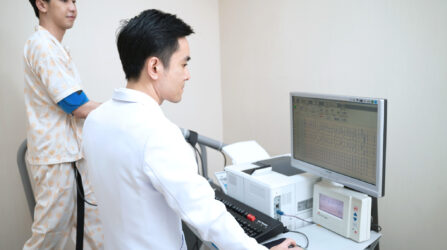
Echocardiography is used to assess abnormalities in heart wall motion, measure the volume of blood ejected during cardiac contraction, and visualize a wide range of heart conditions, including congenital heart disease, valvular heart disease, myocardial disorders, and coronary artery disease.
For further information or Booking..


Importance of Cardiac Health Examinations
Many heart conditions do not present noticeable symptoms in their early stages. Regular health check-ups or cardiac health examinations play an important role in identifying potential heart problems and future cardiovascular risks.
When risks are detected early, healthcare providers can implement appropriate preventive measures. If abnormalities that require treatment are identified at an early stage, the likelihood of recovery and improvement is significantly higher than in cases where the disease has progressed and symptoms have become more severe.
Who Should Undergo Cardiac Health Examinations?
• Individuals aged 40 and above: Both men and women, as well as individuals under 40 who have additional risk factors.
• Individuals at increased risk: Those with diabetes, high cholesterol, or high blood pressure.
• Unhealthy dietary habits: Individuals who frequently consume foods high in sugar, fat, salt, or processed ingredients.
• Smokers: Regular smokers or individuals who are frequently exposed to secondhand smoke.
• Family history: Individuals with a family history of heart disease, such as coronary artery disease.
• Stress and fatigue: Individuals experiencing chronic stress, insufficient rest, poor sleep quality, or persistent fatigue.
What Is Echocardiography?
Echocardiography is a diagnostic test that uses high-frequency sound waves to examine the heart. This examination employs ultrasound waves directed toward the heart. The sound waves reflected back from the heart structures are converted into images displayed on a screen or recorded as images or video.
By moving the transducer across different areas of the chest, echocardiography provides detailed images of the heart and major blood vessels. It allows physicians to evaluate heart contraction and relaxation, blood flow, and valve function.
In addition to placing a transducer on the chest wall, the examination may involve inserting a specialized probe through the esophagus to obtain clearer images of the left atrium, heart valves, and interventricular septum. This technique is known as transesophageal echocardiography (TEE).
Benefits of Echocardiography
Echocardiography offers several important clinical benefits. It is used to detect abnormalities in heart wall motion, evaluate the volume of blood pumped with each heartbeat, assess the thickness and condition of the pericardium (the membrane surrounding the heart), and identify fluid accumulation between the pericardium and the heart muscle.
These findings assist physicians in diagnosing and monitoring various heart conditions, including congenital heart disease, valvular heart disease, myocardial disorders, and coronary artery disease.
Types of Echocardiography
There are four main types of echocardiography:
-
M-Mode:
This basic mode produces a one-dimensional image and is commonly used to evaluate the movement of the heart walls. -
Two-Dimensional (2D):
This widely used mode generates two-dimensional images, allowing visualization of the heart’s structure in both width and depth. It is useful for assessing cardiac motion and observing the opening and closing of heart valves. -
Doppler Echocardiography:
This mode measures the speed and direction of blood flow within the heart and blood vessels. It is particularly helpful in evaluating valve function and detecting abnormal blood flow between the heart and blood vessels. -
Color Doppler Echocardiography:
This technique adds color to Doppler imaging to represent the direction and velocity of blood flow. It assists in assessing valve function, detecting abnormal connections between blood vessels and the heart, evaluating blood vessel structure, and examining the heart chambers.
For further information or Booking..

 Building A, 1st floor.