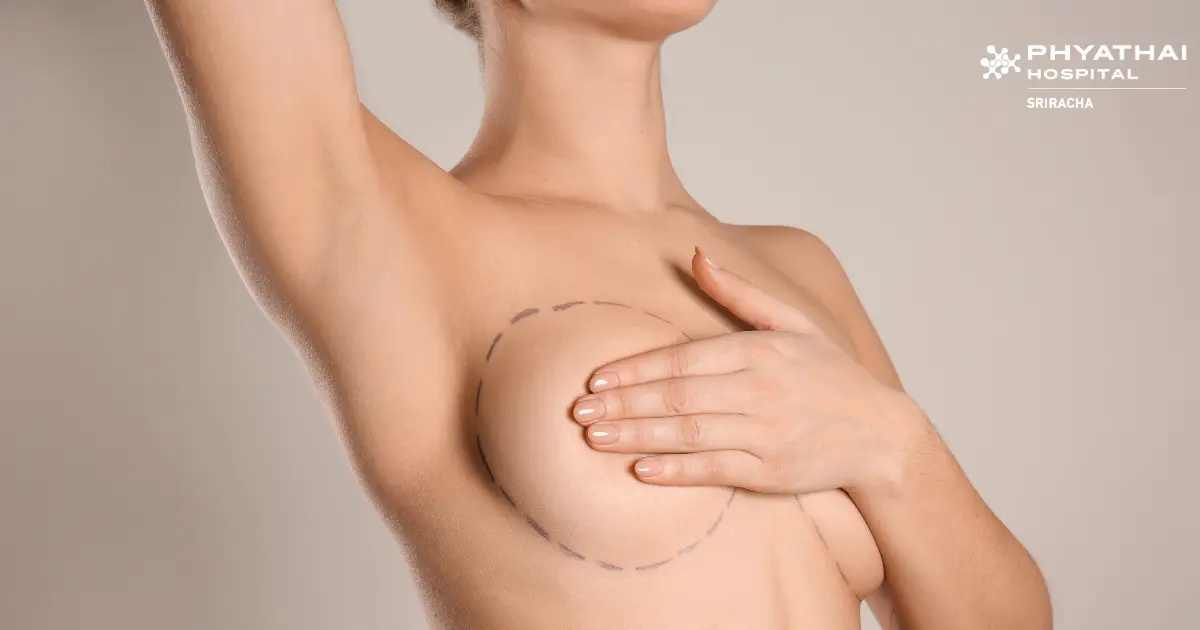
Breast augmentation surgery that achieves a well-proportioned size and aesthetically pleasing shape can significantly enhance a woman’s body contour, confidence, and overall self-image. However, to achieve safe and long-lasting results, it is essential to understand key information about breast augmentation before undergoing the procedure. Below are important considerations to help ensure both beautiful and safe outcomes.
Types of Breast Implants
Currently, breast implants are generally classified into three main shapes:
1. Round Implants
Round implants are available with either smooth or textured surfaces and are the most commonly used type. They create a fuller upper breast contour and enhance cleavage. Round implants also allow for a wide range of size options based on patient preference.
The cohesive gel inside round implants is relatively softer than that of teardrop implants, making surgical placement easier.
2. Teardrop (Anatomical) Implants
Teardrop implants are shaped to mimic the natural contour of the breast, with less fullness in the upper portion and more projection in the lower portion. This design closely resembles the natural breast shape when standing or sitting.
This implant type is ideal for slender patients who desire a natural-looking breast with subtle upper fullness and without a prominent cleavage.
3. Ergonomix (Semi-Teardrop) Implants
Ergonomix implants combine the advantages of both round and teardrop implants. The implant adapts to body position—appearing teardrop-shaped when standing and rounder when lying down.
The gel is firm yet flexible, designed to fully recover its shape (100% shape memory), providing a natural appearance and long-lasting results.
Implant Surface Types
Smooth Surface Implants
Smooth implants have a soft, flexible, and clear surface, allowing the cohesive gel inside to be visible. They are easy to insert and suitable for larger implant sizes.
However, smooth implants have a higher risk of capsular contracture (breast hardening) compared to other surface types.
Textured Surface Implants
Textured implants have a slightly rough surface designed to reduce implant movement after surgery. The textured surface helps the implant adhere to surrounding tissue, lowering the risk of implant displacement and capsular contracture.
Nano / Velvet Surface Implants
Nano or velvet surface implants combine the benefits of both smooth and textured surfaces. The surface is soft and smooth, making insertion easier, while still reducing the risk of capsular contracture.
These implants integrate well with breast tissue, provide a natural feel, and have a longer lifespan.
Implant Placement Techniques: Which Is Right for You?
Over-the-Muscle (Subglandular Placement)
Suitable for patients with sufficient natural breast tissue and fat. The implant is placed above the chest muscle, allowing for a softer appearance and quicker recovery.
Under-the-Muscle (Submuscular Placement)
Ideal for patients with sagging breasts or limited breast tissue. This placement provides better breast shape, a more natural contour, and reduces the risk of capsular contracture.
In the early postoperative period, the implant may appear slightly elevated and may move with chest muscle contraction.
Dual-Plane (Partial Submuscular Placement)
In this technique, the upper portion of the implant is placed beneath the chest muscle, while the lower portion lies directly beneath the breast tissue.
This approach combines the benefits of both techniques, resulting in a natural breast shape, improved upper coverage, and a reduced risk of capsular contracture.
Preoperative Preparation for Breast Augmentation
-
Complete a physical examination, blood tests, chest X-ray, and electrocardiogram as indicated
-
Avoid food and water for at least 6 hours before surgery
-
Discontinue certain medications, such as blood thinners (e.g., aspirin), vitamins, and herbal supplements as advised by your doctor
-
Stop smoking and avoid alcohol consumption for at least 4 weeks prior to surgery
Breast Augmentation Procedure
-
The procedure is performed under general anesthesia administered by a qualified anesthesiologist
-
The surgeon creates a pocket in the chest area, inserts the implant according to the preoperative plan, and closes the incision
-
The surgery typically takes approximately 40 minutes to 1 hour
Recovery Period
-
Initial recovery usually requires 1–2 days of rest
-
A follow-up appointment is typically scheduled about 7 days after surgery
-
Most patients can return to work within a few days, depending on individual recovery
-
Patients should avoid direct pressure or impact to the breasts (except for wearing a supportive bra)
-
Surgical scars will gradually fade over time, with healing varying from person to person
Postoperative Care
-
Avoid lifting heavy objects (over 10 kg) for several weeks
-
Refrain from strenuous activities or intense exercise for approximately one month
-
Wear a supportive bra as recommended by the hospital during the first month after surgery
Breast Augmentation at Phyathai Sriracha Hospital
At Phyathai Sriracha Hospital, we are committed to delivering safe, high-quality breast augmentation procedures under international standards:
-
Surgery performed in a fully accredited international-standard hospital
-
Procedures conducted by board-certified plastic surgeons
-
General anesthesia administered by specialized anesthesiologists, ensuring patient comfort and safety
-
Small surgical incisions (approximately 3–4 cm) that heal into fine, natural-looking scars
-
Short operative time with faster recovery and minimal discomfort
-
Endoscopic-assisted techniques used in all cases to ensure precise implant placement, natural breast shape, and proper positioning
-
No surgical drains required
-
Significantly reduced risk of capsular contracture, resulting in softer, more natural-feeling breasts

 Building B, 7th Floor