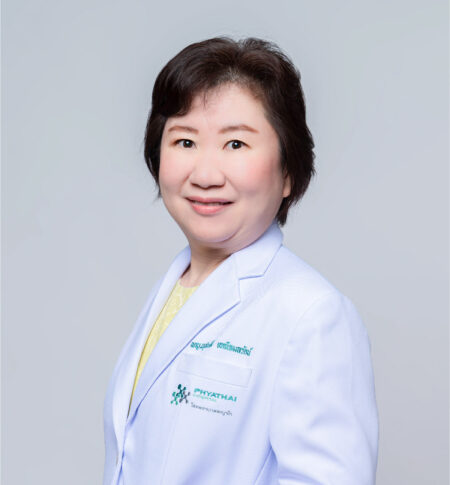

Dr. Nutnatee Akkomonrat
The doctor places great emphasis on explaining the disease to parents, ensuring they clearly understand the treatment process and the expected recovery period for each condition. In some cases, it is not only the parents who need this information—other family members involved in the child’s care may also require additional explanation. The doctor believes that when knowledge and understanding are shared, everyone can work together more confidently and comfortably to provide the best possible care for the child.
Pediatric Pulmonology with Compassionate, Family-Centered Care
After earning her Doctor of Medicine degree from the Faculty of Medicine, Siriraj Hospital, Mahidol University, Dr. Nutnatee Akkomonrat pursued further training and obtained a Certificate in Pediatrics at Chonburi Hospital. She later expanded her expertise by completing a Certificate in Pediatric Pulmonology at Ramathibodi Hospital. Reflecting on her journey, she shared the inspiration behind her career choice:
“I have always loved children. During medical school, I was fortunate to have a highly capable pediatrician as my mentor. Watching them save the lives of infants and young children left a deep impression on me. That experience inspired me to become a skilled pediatrician and to care for children with the same dedication.”
Choosing Pediatric Pulmonology
After becoming a pediatrician, Dr. Nutnatee initially planned to specialize in pediatric nephrology. However, during her clinical exposure at Ramathibodi Hospital, she recognized the growing importance of respiratory diseases in children.
She observed an increasing number of pediatric respiratory conditions linked to environmental factors, air pollution, and allergens, along with a shortage of specialists in this field at the time. This realization led her to change her focus and pursue advanced training in pediatric pulmonology.
Common Conditions and Scope of Care
Dr. Nutnatee’s primary responsibility is the diagnosis and treatment of respiratory diseases in children. At Phyathai Sriracha Hospital, the majority of her pediatric patients present with:
-
Allergic conditions and respiratory allergies
-
Asthma
-
Respiratory infections, such as colds and chronic cough
-
Sleep-related breathing problems
In complex or severe cases, she works closely with ENT specialists to develop comprehensive treatment plans.
She provides care for children from birth to approximately 14–15 years of age. Treatment typically involves medication, but certain conditions may require diagnostic procedures such as nasal endoscopy.
Understanding Children, Supporting Parents
Because Pediatricians Care Like Mothers Too
Caring for children often means managing fear, anxiety, and resistance during examinations or treatment. Dr. Nutnatee approaches each situation with calmness, empathy, and patience.
“Children who come to see the doctor are usually unwell, uncomfortable, or afraid. Their emotions can vary depending on their age and developmental stage. When we understand this, it becomes easier to guide them through the process.
As pediatricians, we care for our patients much like our own children. Nurses, parents, and caregivers all play an important role in helping children feel safe and cooperative. In our department, we also provide toys and child-friendly environments to ease anxiety.”
When parents feel stressed or overwhelmed, Dr. Nutnatee’s maternal approach allows her to empathize deeply with their concerns.
She places strong emphasis on clear communication, explaining:
-
The nature of the illness
-
The treatment plan
-
The expected recovery timeline
When extended family members are involved in caregiving, she ensures they also receive appropriate explanations.
“When families share the same understanding, they feel more confident and at ease working together to care for the child.”
Close Monitoring Saves Lives
For serious illnesses, attentive monitoring and early intervention can be life-saving. Dr. Nutnatee highlighted dengue fever as an example of a condition that requires careful observation.
“Most children with dengue recover well without complications. However, in rare cases, subtle warning signs may indicate a more serious condition. I once cared for a child with dengue who showed early signs of plasma leakage. Careful monitoring of blood concentration and heart rate helped identify the problem early.
Because the condition was detected promptly, we were able to treat the child safely. Without close observation, the situation could have progressed to shock and become life-threatening.”
Dedicated to Safe, Compassionate Pediatric Care
Dr. Nutnatee’s approach combines clinical expertise, vigilant monitoring, and compassionate communication. By understanding both children and their families, she strives to provide care that is not only medically sound but also emotionally reassuring—ensuring the best possible outcomes for her young patients.